Shaping the city of tomorrow: toward the productive city
We are in the midst of a profound transformation. Climate change challenges us, but so does structural change, which is altering the way we live, work, and interact within urban space. Particularly in the knowledge economy, innovation today relies more than ever on diversity, networking and exchange. At the same time, there is growing awareness that cities cannot thrive on services and knowledge work alone. A truly productive city also depends on tangible, material production as a core economic activity.
Despite extensive professional discourse around mixed-use development, our cities are still largely shaped by mono-functional planning principles.
After nearly a century of separating functions we lack role models for successful mixed-use developments. The ecological, economic, and social benefits of such integration remain underappreciated. The productive city of tomorrow demands that we engage with complex societal, economic, and environmental developments, and translate those insights into new, multifunctional neighbourhoods. To meet increasingly greener urgent and fast-evolving challenges, we must actively shape structural change and jointly develop new approaches with foresight. The goal is to transform existing, isolated areas into interconnected neighbourhoods in which production is a natural part of the urban fabric. As manufacturing re-enters the city, blending seamlessly with other aspects of urban life, new contrasts will emerge. We will need to embrace these frictions. But within these “collision spaces” lie the seeds of innovation, and a richer urban experience, sparking fresh synergies between residential, commercial, and industrial life with a high potential for economy and society.
Technological progress is reshaping work and the city
Technological innovation has always been a driver of societal and spatial change. During the Industrial Revolution in the 18th and 19th centuries, cities rapidly urbanized as production processes were centralized, e.g. in the Ruhr region. In contrast, the digital revolution of the late 20th century brought globalization and dispersed production to the edges of cities or across the globe.
Now, in the 21st century, we are witnessing a new wave of disruptive technologies like artificial intelligence. These developments are once again reshaping markets and elevating the role of knowledge work. Particularly in high-tech industries, production, research, and development are becoming more tightly interwoven. And because knowledge, and therefore also production knowledge, is strongly linked to people and places, completely new demands are being placed on spaces where we work. Yet our cities remain shaped by an outdated model: the functionally separated city of the 1933 Athens Charter. In favor of efficiency and in response to the health problems caused by high-emission production in the cities, the charter provided for strictly segregated zones for work, life, commerce, and leisure. While the past century was characterized by systematic spatial separation and the drive for growth and mass production that emerged particularly in the second half of the century, today a new awareness emerges, of the finite nature of our resources and the fact that our society and its potential for innovation do not live from separation, but to a large extent from networking and exchange.
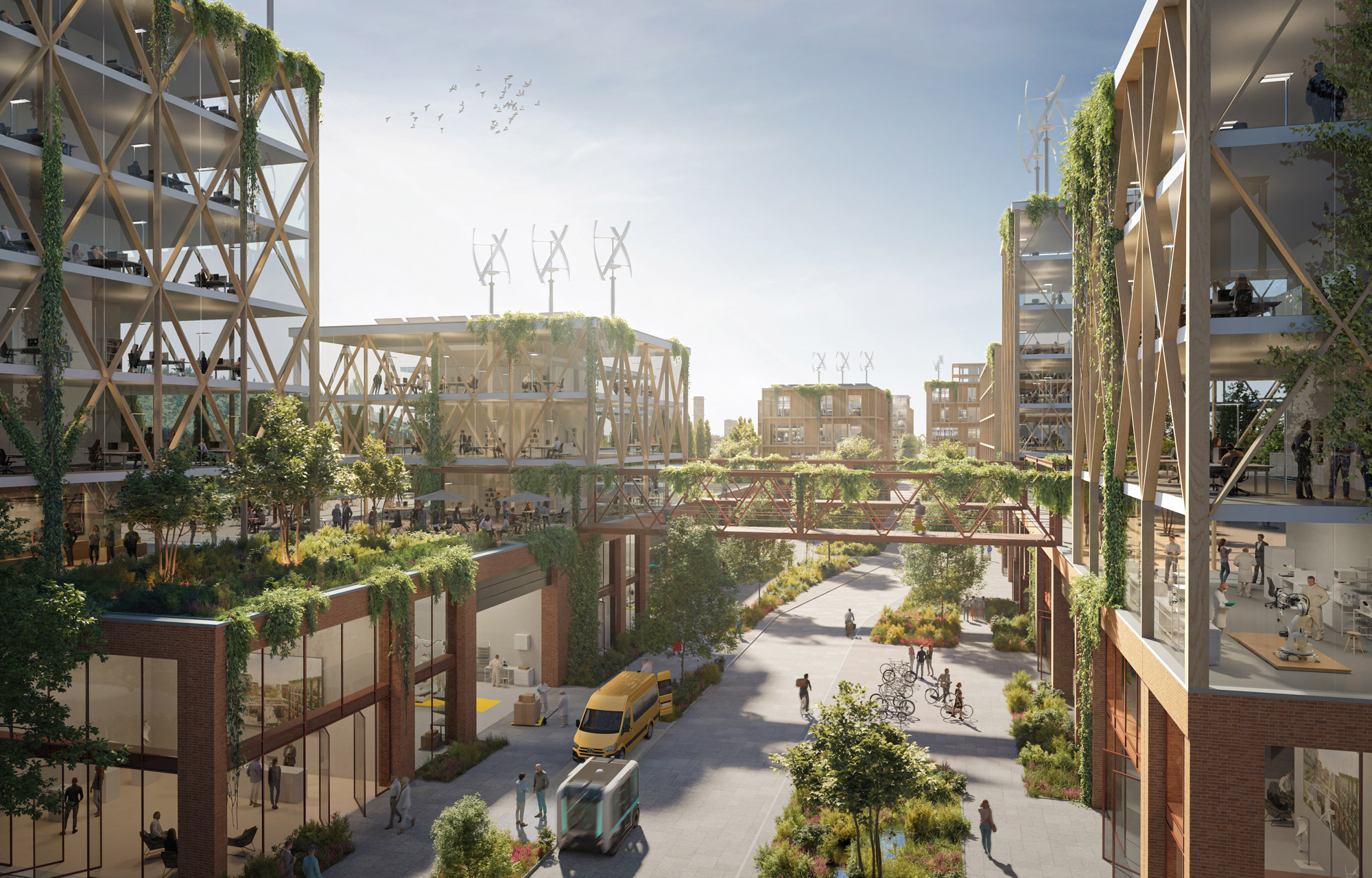
A new perspective on work and industry
Structural change is altering the products, processes and spaces in which we work. One of the most striking shifts in this transformation is the growing overlap between life and labour. Flexible work models are now the norm across many sectors, and toggling between remote and in-person work has become routine. At the same time, we are witnessing a redefinition of work itself: knowledge-based jobs are gaining ground, while the traditional distinctions between blue- and white-collar work are becoming increasingly blurred. Today, innovation emerges from the close integration of production and development. In their monograph The Industrious City: Urban Industry in the Digital Age (2021), the Swiss architects Hosoya Schaefer explore how this integration could take shape. They call for a deeper understanding of “industry”—not merely as a set of capital-generating production means, but in the spirit of the word’s Latin root and its English cousin industrious: diligent, resourceful.
This is “closer to its Latin root and emphasizes the know-how and eagerness to work that are intrinsic to people and places”⁴.
In our context, this means moving beyond the narrow view of industry as a zone for manufacturing capital goods. Instead, we recognize that value lies not only in the finished product but also in the effort, knowledge, and skill embedded within it. In this original sense, industry and production become vital elements of a Productive City, a place where living, working, and making coexist.
Hiromi Hosoya and Markus Schaefer write in their “Agenda for an Industrious City”: “The industry that is returning to the city is very different from the 20th century industry that left the city. “The industry returning to the city is not the same as the one that once left. Where 20th-century industry meant foundries, assembly lines, and smokestacks, today’s industry includes semiconductors and nanotech, materials science and chemistry, software, art, and design. Its spatial footprint is closer to the human scale. Not only is the city becoming more industrial again, but the industry itself is becoming more urban.”
This stronger symbiosis between making and thinking, between people and place, calls for new spatial models that reflect these changes. Thankfully, new technologies allow production to be far cleaner and quieter than in the past, opening up the possibility for proximity between industrial and other urban uses. It is a chance to reintegrate fragmented, mono-functional zones back into the rich fabric of the city.

Too narrow a focus obscures the view of regional contexts
In current conversations around the future of work, much attention is given to the design of the individual workplace: how to make offices more flexible, collaborative, or emotionally engaging, think “New Work” or “campfire culture.”
And the discussion takes place primarily on an emotional, purely social level. Yet this narrow focus often misses the bigger picture. The transformation of work encompasses far more than this perspective. What is often overlooked is the broader urban and regional context in which workplaces are embedded: business parks, industrial zones, inner-city office districts.
Structural change never affects only isolated pockets; the actual dimension is usually only visible in a regional context.
In fact, in Germany alone, industrial and commercial land made up 18.7% of total settlement areas in 2022. That’s nearly a fifth of populated area.
It is therefore not only the demands on individual workplaces that are changing, but also the need for commercial and industrial areas that were once conceived as exclusive workspaces, as well as for large-scale, inner-city office and administration buildings.
Take the Stuttgart metropolitan region, for example, a place still deeply rooted in production. In our project work with mid-sized companies in the area, we are increasingly focused on how production and development can be more closely interlinked in terms of content and location in order to create space for innovation and new collaborations. While new technologies automate many aspects of manufacturing, production knowledge remains anchored in expert networks, tied to defined places. At the same time, these technologies open up possibilities for low-emission production. This creates new opportunities for co-location with more sensitive urban uses, housing, education, public spaces.
The urban quarter as a network
For decades, the development of industrial and commercial areas has prioritized efficiency: streamlined infrastructure, maximally flexible plots, and space tailored to each new business or product. What often got lost along the way was the bigger picture.
This “ad-hoc urbanism” has resulted in rigid, deeply rooted structures that no longer meet the needs of today’s companies or their cultures. Essential aspects such as identity and orientation, places for interaction and communication, spaces for synergies and cooperation, amenities like childcare, dining, or communal areas were rarely considered.
Yet these are precisely the ingredients that turn a mere area into an urban quarter. While an area is a pragmatic patchwork of functions, a quarter is a vibrant mesh of encounters, a place where uses intersect and people come together in all facets of life. This is not just a place where a variety of uses come together.
Economic success and the capacity for innovation increasingly depend on tightly woven links between production and knowledge. And knowledge, in turn, is deeply influenced by soft location factors, such as culture and quality of life. The closer the relationship between making and thinking, the closer the spatial proximity must be. This is why formerly isolated, mono-functional zones are evolving into multifunctional, highly attractive knowledge quarters. Here, research, development, and production are not just side-by-side, they are fully integrated into the urban landscape, in constant dialogue with housing, leisure, education, and nature.
A mindshift for a future-proof city
To realize the vision of an urban district where industry is truly integrated, we need a fundamental mind shift, not just within companies, but also among planners and policymakers. Traditional silos of responsibility and conventional planning concepts must give way to a more collaborative understanding of how city and industry can work together.
The aim should be to create a resilient and future-oriented piece of city, one that seamlessly weaves together production, research and development, commerce, housing, education, leisure, and landscape within a compact footprint. Like a neural network, these diverse needs must be coordinated into a cohesive process.
Crucially, this process must begin with a clear and future-proof vision, while remaining adaptable to changing needs over time.
After all, one thing is certain: When work changes, the city changes too.
Five theses for the future of industrial and commercial areas
The following theses can serve as building blocks for the further development of existing industrial and commercial areas.
The essay is part of the comprehensive publication “Dream Factories”, which has now been published by Penguin Random House.