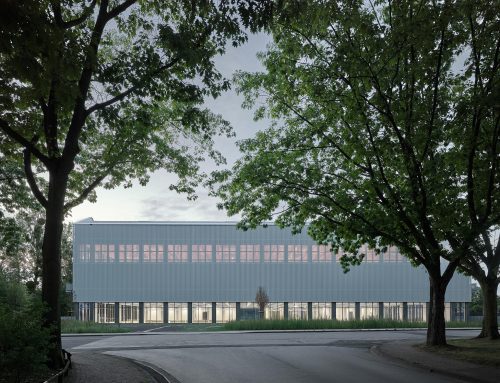
Hybrid centrepiece
We have transformed a community hall in Kirchheim am Neckar that dates back to the 1970s and adapted it to meet new requirements. The result is a multifunctional building that once again lives up to its significance as place of encounter.
They can be found everywhere, referred to locally as town halls, community halls, or sometimes community centres. They symbolize the desire for a place of gathering and civic encounter. Many of these buildings were constructed in the 1960s or 1970s and have since not only aged but also become functionally outdated. A successful example of how such a space can be revitalized while preserving the existing structure is the Gemeindehalle in Kirchheim am Neckar. The project was recognised by the Baden-Württemberg Chamber of Architects as part of its ‘Exemplary Construction’ initiative in the Ludwigsburg district.

The brief called for the accommodation of important community functions, such as a daycare centre and a sports hall, and to adapt them within a limited budget. This presented an opportunity to optimise the building’s use making it more versatile for the community and allowing it to be used around the clock in future, from children in the morning to local clubs and associations on weekends.

A Vibrant Façade Design
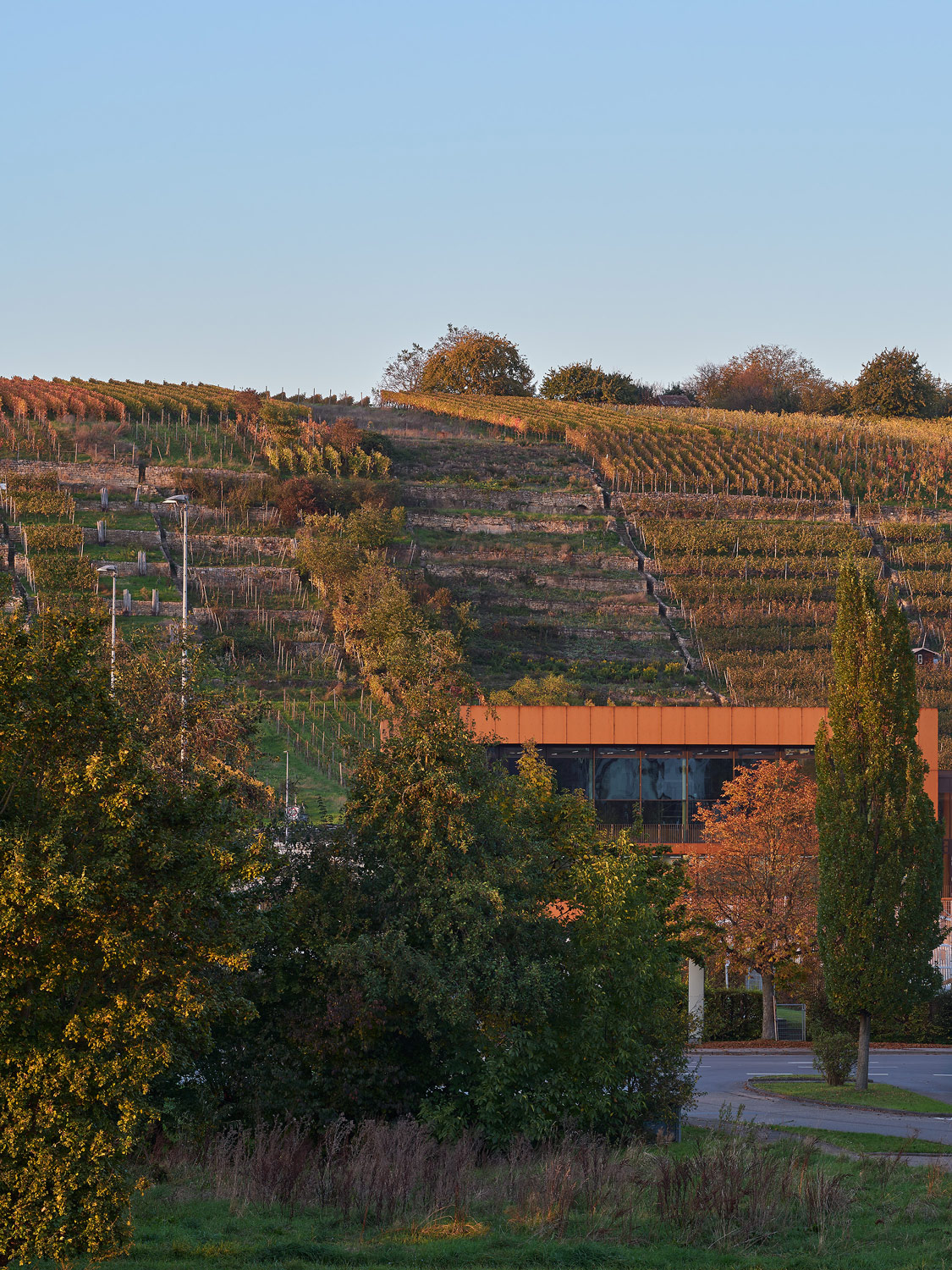
The Gemeindehalle is located just outside Kirchheim, set within a picturesque landscape. The backdrop is a bowl-shaped terrain with vineyards, formed from a former branch of the Neckar River. To symbolically connect the hall with its surroundings, the façade material was chosen to reflect seasonal changes, much like the vineyards themselves. Corten steel was selected for its warm autumnal hues, exceptional durability, and low maintenance requirements.


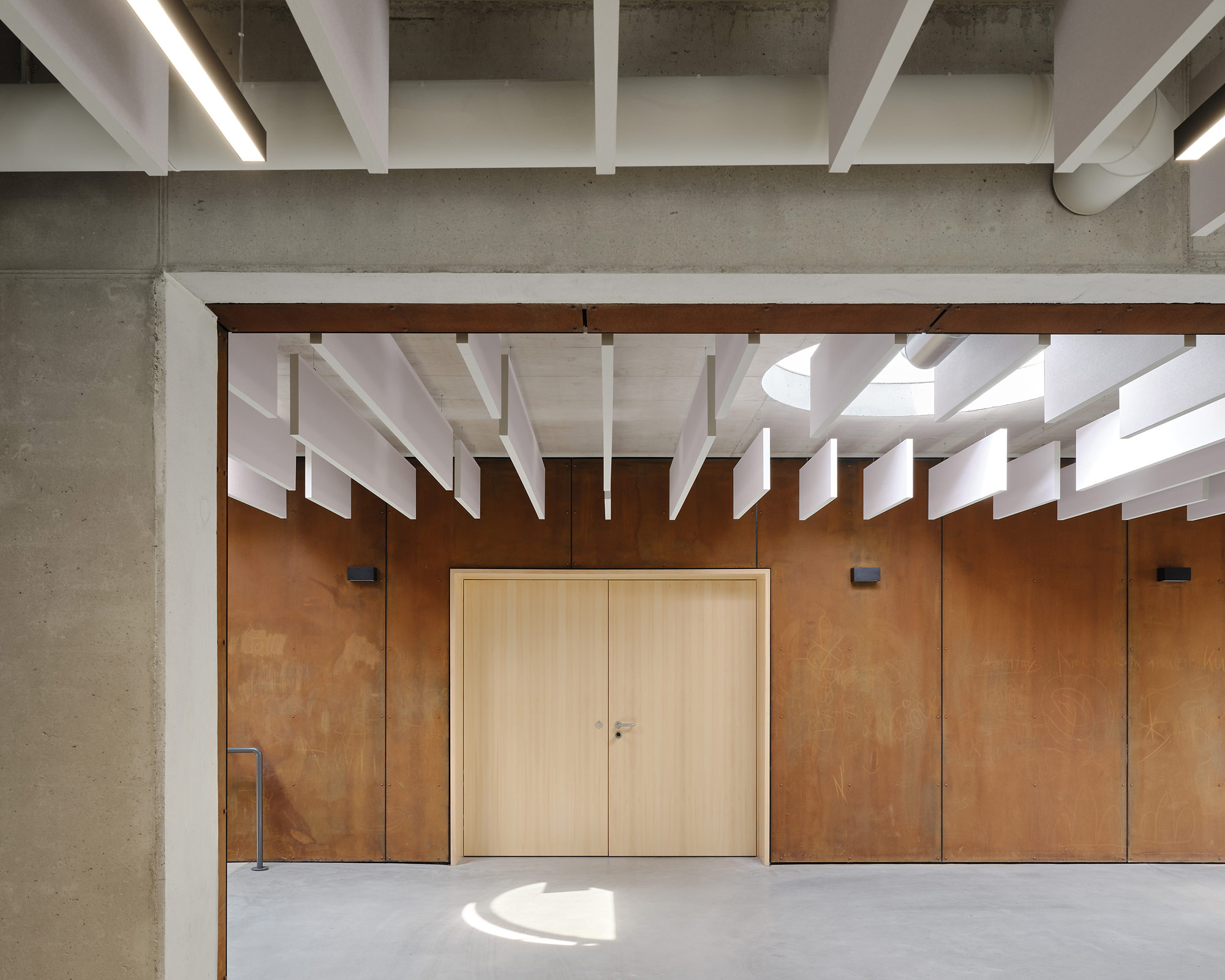
While the left portion of the hall was renovated and preserved, the right section, due to its structural condition, was demolished, rebuilt, and adapted to the new programmatic needs. To clearly differentiate the various functions while maintaining a visual and spatial connection, the original massing and the distinctive central connecting volume were retained. Inside, the Corten steel continues to clad this central volume, enhancing the dialogue between interior and exterior. Skylights facilitate natural illumination and, depending on the sun’s position, cast striking shadow patterns across the Corten-clad walls.
A striking detail: the intermediate structure not only serves as an important link between all functions, it also houses the main and rear entrances. Both entrances are fully glazed, making the proximity to the vineyards almost tangible. Upon entering the hall, one has the feeling of walking directly towards the vineyards.



Multifunctional programmatic and design concept
The building’s façade clearly reflects its diverse functions: the right section features smaller, more intimate openings marking the spaces of the new daycare centre, while the upper floors of the left section, with the Gemeindehalle, the locally called Bädle, the sports hall, and the rear-positioned gymnastics hall are articulated with larger openings.
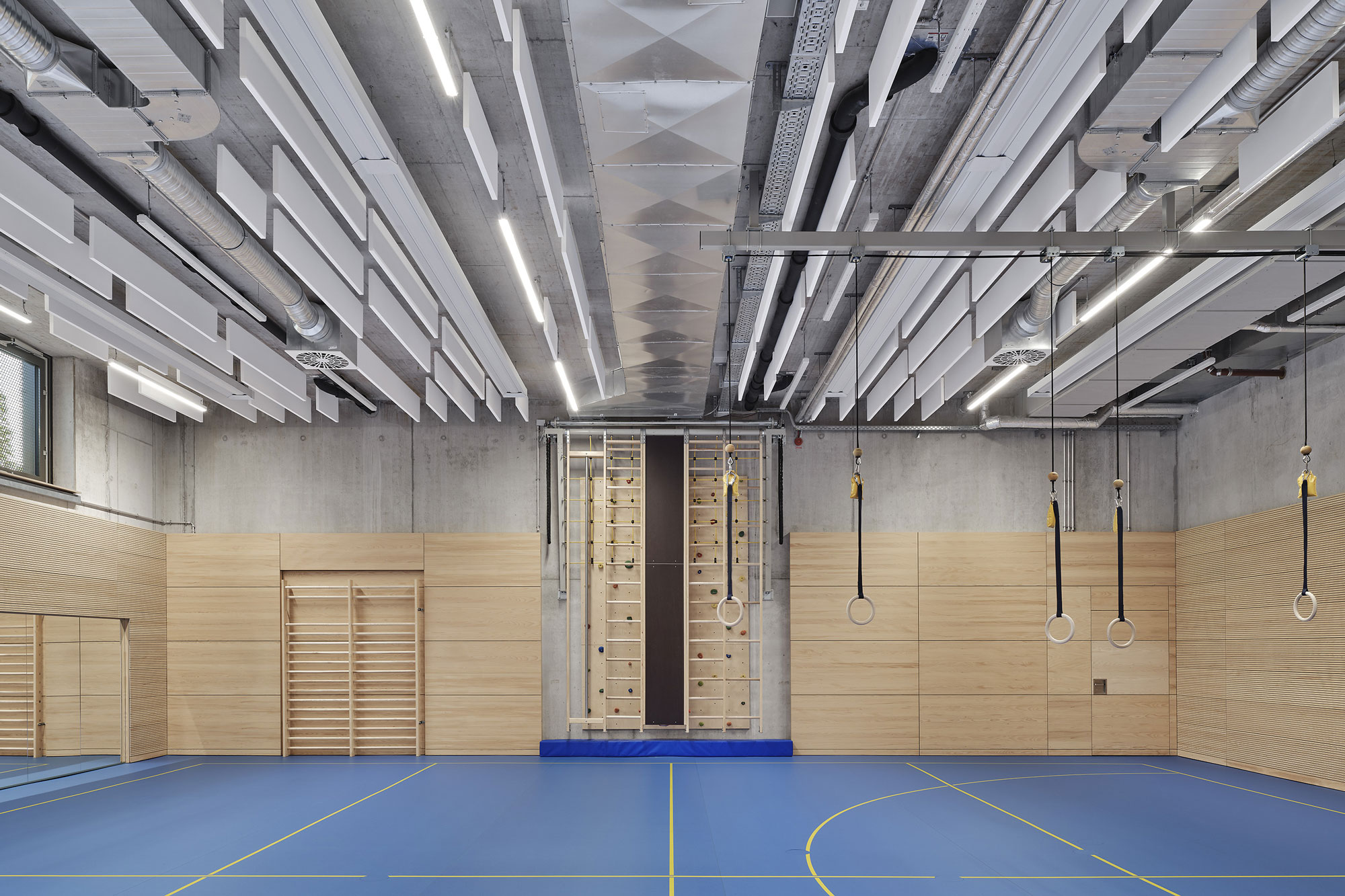
At the heart of the building lies the Gemeindehalle itself. With a large stage, capacity for up to 800 people, and a full-height glass façade opening onto the forecourt, it provides a contemporary venue for community events and celebrations. Directly beneath, the Bädle, a teaching swimming pool primarily used by school classes, was renovated. An additional sports hall with changing rooms was integrated into the basement to accommodate local sports clubs and classes.
The daycare centre Klecks-Box, located in the right building section, spans three floors and provides space for up to 60 children. The interiors are designed to support the open-concept educational approach, offering varied spatial qualities depending on the floor: a generous outdoor area on the ground floor, a cafeteria and atelier on the first floor, and administrative rooms as well as playrooms on the second floor.
Materials are consistently used across both building sections and all levels. For example, rubber linoleum is applied in both the daycare and sports areas, while exposed concrete screed lines the circulation zones. A recurring design element is the wooden slat cladding, which imparts warmth to large-volume spaces such as the sports hall, gymnastics hall, and Gemeindehalle. To aid orientation, each floor features its own distinct colour scheme.


Project information
Projektname: Gemeindehalle Kirchheim am Neckar
Location: Kirchheim am Neckar
Project type: Replacement construction and modernisation
Completion: 2024
Client: Municipality of Kirchheim am Neckar
Cooperation: EGSPlan, Stuttgart (TGA) / Corall Ingenieure GmbH, Meerbusch (Brandschutz) / KMB PLAN | WERK | STADT | GMBH, Ludwigsburg (Freianlagenplanung inkl. Kita Außenbereich) / Wenzel+Wenzel Stuttgart (Objektüberwachung) / Jörn Genkel (Ausschreibungen) / Holzbau Amann GmbH, Weilheim-Bannholz (Holzbau) / Wittenauer GmbH, Sasbach (Cortenfassade)
Team: Daniela Boog, Sally Al-Ejeilat, Thomas Herold, Florina Dietz, Hannah Kölbl, Alma Ibralic
Award: Exemplary Construction in the Ludwigsburg District 2019–2025
Images: Zooey Braun