From Lignite Mining Area to Circular Innovation Hub
The coal phase-out by 2030, as determined by the federal government, presents the Rhineland mining region with both a major challenge and equally significant potential. Once characterized by open-cast mining, the former lignite area is set to become synonymous with high quality of life and innovation in the future, laying the foundations for a sustainable living and economic environment. Located in close proximity to the major cities of Cologne, Düsseldorf, and Aachen, the region is now seeking a new identity against the backdrop of structural transformation. At the heart: the city of Eschweiler.
On the approximately 11,000 square metre site of a former slaughterhouse, an innovation and commercial centre is to be built over the next few years – resource- and climate-friendly centre for technology and innovation transfer in the region, with scope for new business models and collaborations. The future use of the site in the field of science and research is not the only focus of innovation. The location itself is intended to embody innovation and therefore reflect this vision in its architecture. The project has been awarded the regional seal of approval by the Zukunftsagentur Rheinisches Revier (Rhenish Mining Area Future Agency) and is funded by the federal government and the state of North Rhine-Westphalia.


The creation of a vibrant neighbourhood
The former slaughterhouse is centrally located, not far from the town hall in Eschweiler’s city centre. It consists of building volumes that originated at different times and in different styles. Already in the competition phase, our design formulated the objective of preserving at least part of this ensemble and consolidating the previously disconnected ensemble components within a unified quarter. Rather than a large, enclosed complex, a vibrant quarter with public character is to be built, offering meeting points and spatial proximity as an incubator for innovation, interwoven with an ecologically valuable environment. Through a modular structure, the design responds flexibly to changing requirements. Reused materials in the spirit of circular construction form a link between history and future.
The site is divided into two courtyards: the western courtyard facing the city, and the eastern courtyard forming the transition to the festival grounds. Approaching from the city centre, the western courtyard with its start-up centre, arrival plaza, and co-working centre forms the new face toward the city. Adjacent to this is a mobility hub with an energy centre. The eastern courtyard houses workshop halls, above which additional workshop floors are stacked following the principle of vertical stacking. Not only the workshop halls but also the upper workshop floors are kept completely flexible, allowing workshops to be accommodated on upper levels if required. To keep the site car-free, a delivery zone is located on the eastern side, providing access to the workshop halls.
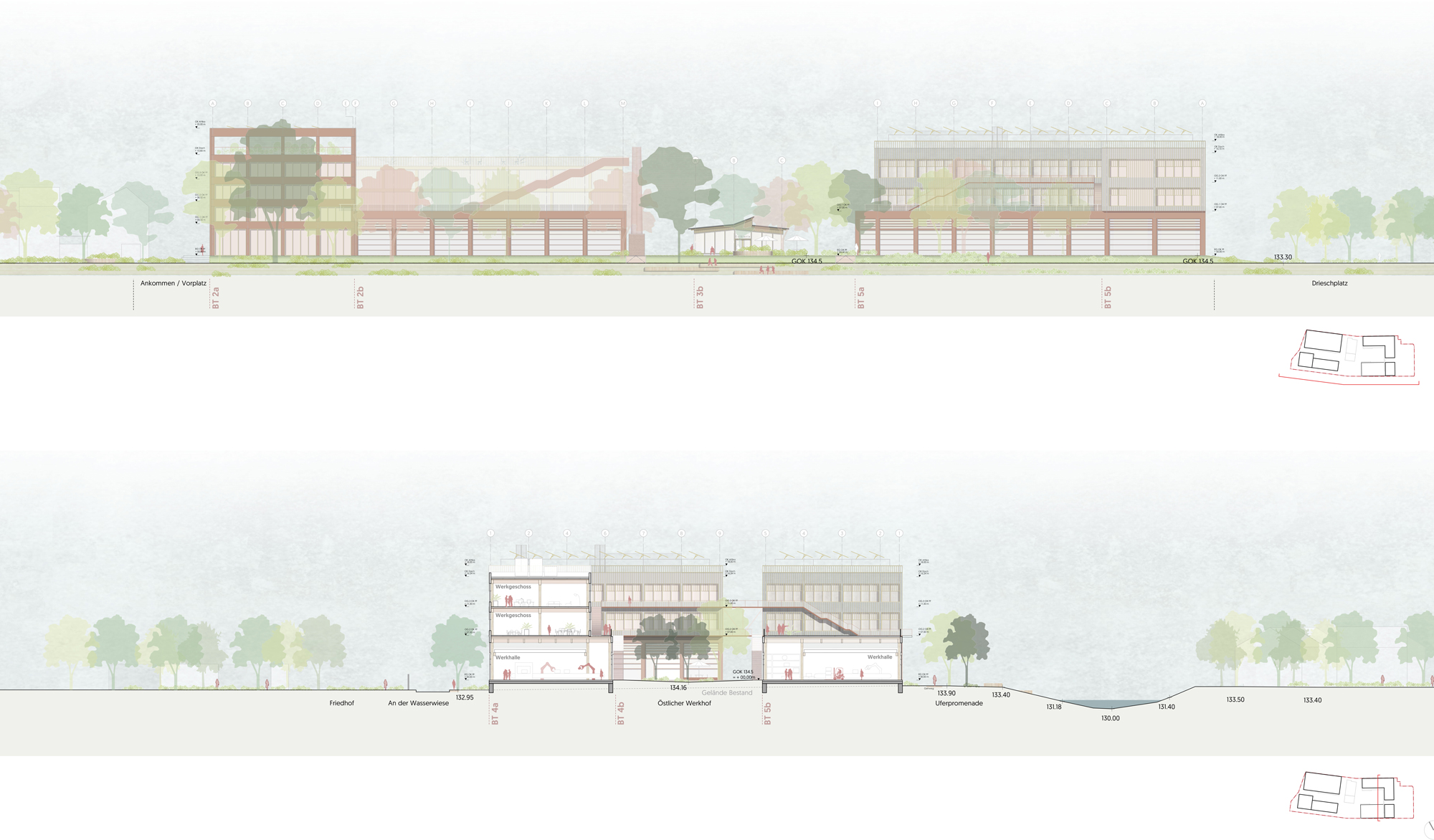
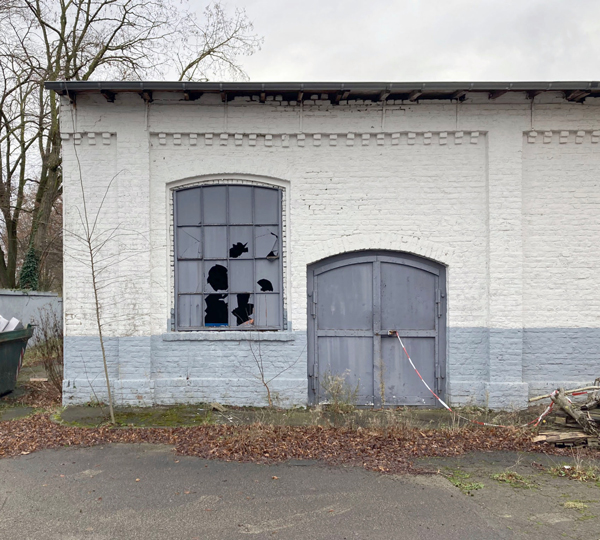
The approximately 100-year-old existing building at the heart of the site serves as the connecting element between the two courtyards. An attached pavilion-style cafeteria opens views to the immediately adjacent Inde terrace. Overlooking the Inde river, this area offers a generous open and green space with high amenity value for users and passers-by.
As an innovation centre and catalyst for structural transformation, the project also sets an architectural example and aims for DGNB certification. Following the principles of circular construction, maximum embodied energy is to be preserved with minimal intervention. Re-use materials are to be employed in both structure and facade, while the use of concrete is to be reduced as far as possible. For instance, Transsolar has developed a sophisticated building services concept geared towards low-tech solutions. In collaboration with Concular, investigations are also underway to determine the extent to which reclaimed materials and components can be used for the facades. Large-scale PV systems will be installed on the roofs. In addition, the aim is to establish an alternative energy supply that will harness the waste water heat from the canal as one of its sources.
Project information
Project name: Innovations- und Gewerbezentrum Eschweiler
Location: Eschweiler/DE
Project type: New construction & conversion of existing building with extension
Client: City of Eschweiler, Office for Economic Development, Real Estate and Tourism/DE
Cooperation: A24 Landschaftsarchitektur GmbH, Berlin / ZRS Ingenieure GmbH, Berlin / Transsolar Energietechnik GmbH, Stuttgart / CAPE, Kirchheim am Neckar / ZWP Ingenieur-AG, Bochum / Rademacher + Partner Ingenieurberatung GmbH, Düsseldorf / Concular GmbH, Berlin
Project team: David Meurer, Jakob Findeisen, Prottoy Shams, Javier Naranjo Jiménez, Nouran Mansour
Images: asp Architects