Sustainable and Innovative
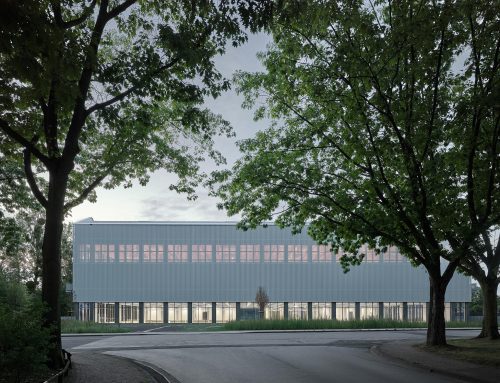
The new VfB Athletic Hall at NeckarPark was completed in a record time of just eight months. From the outside, the resource-efficient wooden structure exudes a down-to-earth feel, while inside it offers a state-of-the-art training and focus facility for VfB Stuttgart’s professional players.
A lot has happened over the past year at NeckarPark, home of VfB Stuttgart. Following the extensive modernization of the MHP Arena in preparation for UEFA 2024, the new athletic training facility was recently completed right next door. Where training had taken place for years in a temporary solution consisting of shipping containers, there now stands a modern wooden structure whose design echoes that of the youth academy right next door.


VfB Stuttgart had specifically requested a building that would be sustainable and, in a certain sense, appear rugged and less ostentatious: The spruce wood structure remains visible, and exterior color accents are kept to a minimum. Thanks to a high degree of prefabrication, the lightweight timber structure was successfully erected within a few months. The design directly accounted for future demolition, and great emphasis was placed on maximizing the use of eco-friendly building materials: All materials are resource-efficient, separable, and healthy. For example, the cavities were insulated with cellulose made from recycled paper. The insulation standard far exceeds legal requirements. The roof was extensively greened and equipped with PV modules. A heat pump supports the energy supply.

From the outside, the athletic hall features a facade of pre-weathered larch slats and external sunshades. Depending on the viewing angle and the daylight, dark red facade panels shimmer through behind them—a nod to the red, curved slats of the youth academy and the club colors of VfB Stuttgart. The interior also features plenty of wood, with special elements made of red-stained MDF panels and a concrete wall—which also serves as a training element—adding visual accents.
The volume of the athletics hall is kept simple and mediates between the changes in elevation resulting from the topography. The rectangular structure is divided into two relatively enclosed areas and a transparent central section that offers a view of the training fields directly in front of it. The left side of the building houses a functional space, while the right side features the so-called “altitude room,” where oxygen levels can be reduced and heat introduced for specialized training sessions. Directly above it, like a gallery, is the yoga room. This is a large, open space largely reserved for recovery. It also houses a skill court for reaction and speed training. An office for the coaches is located on the opposite side of the building.

On the upper floor, large windows offer a view into the weight room. There is plenty of space here for cardio training. Fully glazed walls allow for visual connections from the inside to the outside and vice versa, ensuring that the connection between the players on the training fields and those inside the building is always maintained. Inside, bicycles are lined up in front of the window front; behind them stretches a 30-meter-long sprint track made of black artificial turf. A large wooden step bridges the differences in elevation caused by the topography and simultaneously offers the players a training opportunity.


Similar to the color and material design, the lighting concept was also kept in a rather raw and industrial style. In the cardio area, for example, high-bay floodlights were installed, while the weight room features very sturdy-looking tubular lights that highlight the sprint track. To emphasize the minimalist, simple look of the athletics hall, care was taken to integrate the technical equipment into the walls or stairs. Another portion of the technical equipment was housed in the basement. However, to minimize excavation and the amount of concrete required, the building was constructed with only a partial basement.

Project information
Location: Stuttgart
Project type: New construction
Completion: December 2023
Client: VfB Stuttgart 1893 AG
Project Team: Ellen Henriques, Elif Kälberer, Ralph Stäcker, Sally Al-Ejeilat
Structural System: schlaich bergermann partner
Wood Construction: Holzbau Schaible GmbH
Images: Zooey Braun