Transformation of a partially listed school
Modern, yet respectful
The Österfeld School in Stuttgart-Vaihingen is to undergo extensive renovation and be converted into an all-day school. In the VgV procedure (Ordinance on the Award of Public Contracts), our design was awarded first prize.
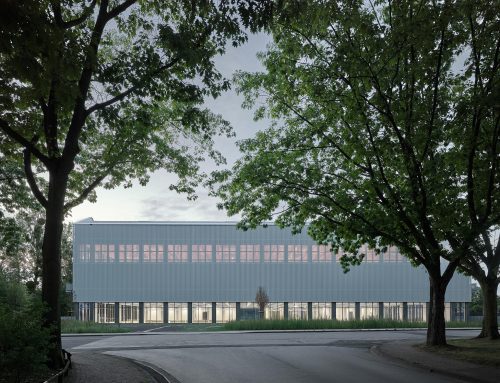
The school grounds are located in a relatively small urban structure and consist of the striking, listed main building from 1902, an extension from 1910 and the gymnasium and assembly hall with a connecting extension from 1953. The buildings are arranged in an L-shape, shielding the schoolyard from the street and neighbouring buildings. The concept of the architects: to preserve the building ensemble as far as possible, to modernise the historic school building as well as the gymnasium and assembly hall, to rebuild the intermediate building and to provide rooms for all-day care, administration and a cafeteria.

Two joints make the new building stand out clearly but respectfully from the existing buildings. Its design language corresponds with its urban context and reinterprets the existing forms of mansard and gabled roofs in a modern way. A plateau provides for accessible entrances to the school on one level. A covered open space will be created as an extension of the canteen, which can be opened up when the weather is nice and allows children to take a break outside even in bad weather. Furthermore, the playground is to be enlarged and supplemented with a green classroom.


Green and interactive
To connect the individual buildings in a perceptible manner, the scheme proposes a central school street, a kind of communal connecting zone and backbone. The street is therefore designed as a sequence of wider and narrower spaces, to which all rooms such as classrooms, multi-purpose rooms or rooms for teaching staff are connected. It offers various open-plan areas, some of which can be partitioned by curtains and sliding walls, providing a variety of options for play and retreat.
In line with climate-conscious construction, all new building components are planned as timber construction, with load-bearing walls, columns, and ceilings made of cross-laminated timber. The roof is supported by laminated timber trusses. Furthermore, the buildings are to be constructed using recyclable structures and materials and the roofs are to be extensively and intensively greened. If a terrace for the teachers is embedded in a roof garden above the canteen, large-scale photovoltaic elements on the non-accessible green roofs and on the roof of the gymnasium and assembly hall will enable renewable energy to be generated.

Project information
Location: Stuttgart
Project Type: VGV-Verfahren 1. Preis 2022
Team: Mete Arat, Hriday Bharaj, Ellen Henriques, Larissa Abdelhadi , Anjali Ramachandran , Raphael Dietz
Visualization: asp