Consistent preservation of existing buildings
on Stuttgart’s market square
Stuttgart’s market square marks a central hub for social inertaction in the city centre. Like few other places, it showcases the history of post-war architecture and redevelopment. Over the years, however, the square has been subject to many alterations, resulting in a loss of identity and significance. With the transformation of the Breitling fashion store, we have set a decisive impulse towards reclaiming the market square as a place for people to meet and enjoy urban life.
Two aspects make our design unique: the existing structure from the 1950s has been consistently preserved and complemented with a new façade design. Through a clear spatial opening toward the square and a renewed programmatic layering that combines catering, tourist information and contemporary workspaces a vibrant urban component has been created, one that redefines the site’s identity and reinstates its civic presence.


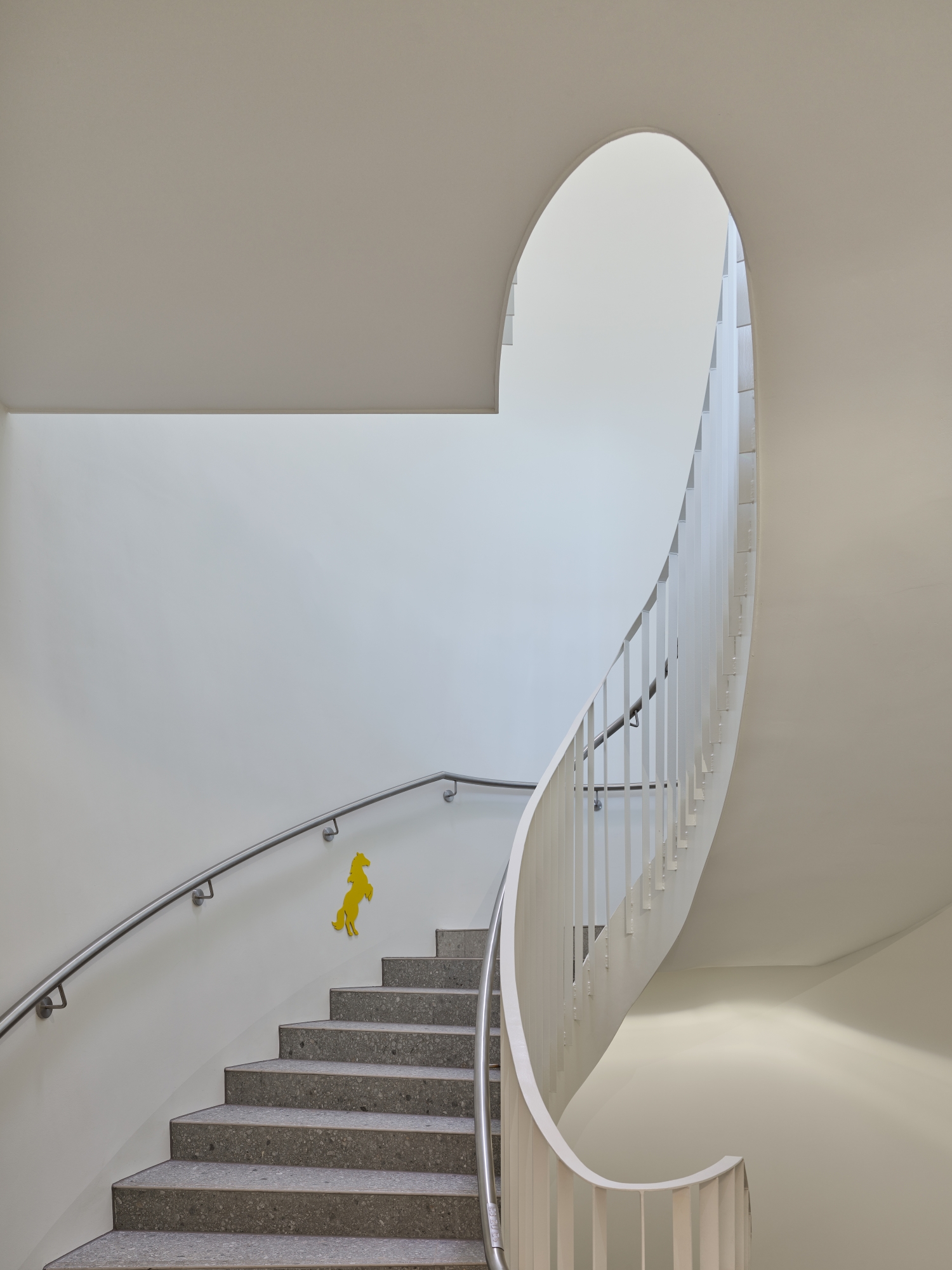
Radical preservation in line with circular construction
The defining decision of the design process was a clear commitment to a rigorous preservation of the existing structure. By preserving and upgrading the original building fabric, approximately 30% of CO₂ emissions were saved compared to a completely new building constructed using conventional methods.
In line with the principles of circular construction, all structural extensions were executed in timber, incorporating biobased materials and components into the building and permanently sequestering CO₂. In total, around 500 cubic meters of timber were used—corresponding to roughly 500 tons of bound CO₂. Structural interventions that could not be realized in timber were executed almost entirely in resource-efficient concrete. All interventions were designed to be fully reversible, ensuring future dismantling and material reuse.
Photovoltaic modules were installed on the roof and parts of the attic façade. Three façades were additionally planted with greenery. The roofs were equipped with green roof systems, contributing to rainwater retention and building cooling, while simultaneously enhancing biodiversity and improving the local microclimate.

Complex planning and construction processes
The entire renovation was guided by the question of how to constructively utilise grey energy within an economically feasible framework. The major challenge was to harmonise the complex structures of the old building, which had developed over many years, with today’s requirements. The goal of continuing to use as much grey energy as possible, preserving the reinforced concrete skeleton and constructively extending it with timber required many specific interventions and measures.
This multitude of distinct structural conditions required a significantly increased level of effort—both in the planning phase and on the part of the executing contractors. The demands placed on each trade were considerably higher than in conventional construction projects, necessitating close interdisciplinary collaboration. The experience clearly demonstrates that consistent preservation of existing structures is not a matter of course, but requires an integrative and coordinated design approach.

Urban Integration & Architectural Expression
The town hall appears on the market square as a dominant urban building block, framed on its northern edge by the finer-grained building structure of the 1950s. To emphasise the importance of the town hall, the tourist office was deliberately integrated into this surrounding fabric.
The façade facing the Market Square forms a central architectural element: it is articulated into four distinct structural segments, each legible in the building’s outward expression. The ground floor, housing the i-Punkt visitor centre and catering, features expansive glazing that opens generous visual connections to the square, creating a welcoming and transparent interface with the public realm. In the upper floors, pronounced framing elements provide the façade with depth and rhythm, referencing the human scale and compositional language of the 1950s context. The recessed rooftop level with its rooftop bar also recalls this architectural era. A newly defined and clearly legible main entrance further anchors the building within the urban fabric, demonstrating its accessibility and open civic character.

Multifunctional Programmatic Concept
In addition to the consistent preservation of the existing structure, the adaptive conversion of the former fashion store into a multifunctional urban building forms a central aspect of the project. Apart from the catering facilities, the interior spaces were designed by Ippolito Fleitz Group.
The ground floor functions as the heart of the new building. It houses the
the exhibition and information space that includes the i-Punkt visitor centre as well as presentation areas for the state capital Stuttgart, the Stuttgart region and the holiday destination of Baden-Württemberg, as well as catering facilities.
The upper floors house versatile office spaces for Stuttgart-Marketing GmbH, Regio Stuttgart Marketing- und Tourismus GmbH, and Tourismus Marketing GmbH Baden-Württemberg. The first floor also accommodates conference and meeting rooms, which can be used by both employees and guests. The spaces have been designed to allow for a wide range of uses, from workshops to traditional meetings.
The office spaces on the second and third floors offer working environments that are geared towards the modern requirements of flexible, activity-based working. Around 50 workstations are available for the employees of Stuttgart-Marketing GmbH and Tourismus Marketing GmbH Baden-Württemberg. The spatial configuration allows users to switch fluidly between open and enclosed zones as needed. From traditional workstations to focused lounges, the varied spatial typologies offer an atmosphere suited to diverse modes of work.


The Rooftop as the Fifth Façade
Undoubtedly one of the highlights of the project is the rooftop terrace. In addition to a rooftop bar, visitors are offered an entirely new perspective over the city center at a height of approximately 16 meters. The roof area is organized into two distinct zones: a covered, weather-protected section with two enclosed timber structures, which opens up towards the market square into a roof area with a translucent but shady slatted structure, which is completely covered with vines. Finally, an open roof garden designed by Koeber Landschaftsarchitektur extends towards the market square, inviting visitors to sit amidst the greenery.
Due to its exemplary nature, the Haus des Tourismus has been included in the IBA’27 network, which complements the IBA’27 projects by bringing together forward-looking initiatives from the Stuttgart metropolitan region. The requirements for admission are ambitious sustainability goals and the courage to embark on new ventures.

Project information
Project name: Umbau des Modehauses Breitling zum Haus des Tourismus
Location: Stuttgart/DE
Project type: Renovation / Modernisation
Client: Stuttgart Marketing GmbH/DE
Opening: Oktober 2025
Cooperation: Turner & Townsend GmbH; Stuttgart / IGG Gölkl GmbH & Co. KG; Stuttgart / EGS-Plan GmbH; Stuttgart / IB Wörtz Part mbB, Pforzheim / Endreß Ingenieurgesellschaft mbH; Darmstadt, Stuttgart / Ippolito Fleitz Group GmbH; Stuttgart / Werkkollektiv Planungs GmbH; Stuttgart/ IGW – Ingenieurgruppe Walter + Partner GBR; Stuttgart / candela GmbH; Stuttgart/ IFP Weber GmbH & Co. KG; Argenbühl/DE + Ingenieurbüro Fassadentechnik – Dipl.-Ing. Rainer Neumann; Erdmannshausen / Koeber Landschaftsarchitektur GmbH / Studio Tillack Knöll GbR; Stuttgart
Team: Marie-Eve Beyer, Dariia Cherkashyna, Raphael Dietz (Projektleitung), Bernhard Heinnickel, Ellen Henriques, Laura Palamattam, Hannah Kölbl, Sabine Kühn, Manuel Martinez, Marta Martinez, Tugce Sahin, Ralph Stäcker, Melek Türkmen, Matthias Wachter
Award:
2026 polis Award // 1st Place: Revitalized Centers
2026 Baden Architecture Prize // Nomination: Renovation of Existing Buildings
Images: asp Architects, Zooey Braun