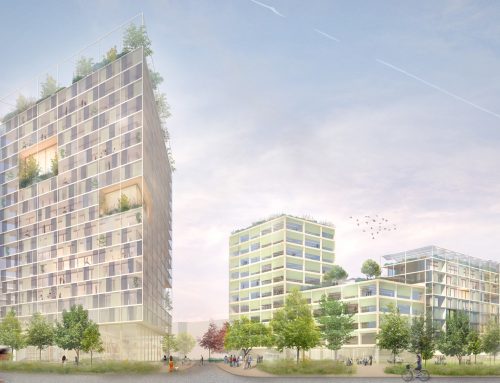
Green und dense
The idea of integrating greenery and orientation towards the landscape in combination with a new density conveys the qualities of historically grown urban structures into an image of a future-oriented city. The concept of a classical, European urban city composed of different neighbourhoods and characterized by diverse, clearly defined spatial sequences is the guiding principle of this design.

Integration and networking
The edges of the district blend with the landscape, avoiding sharp boundaries, incorporating existing landscape elements, and intertwining them with the settlement. A ring road will merge the three independent neighbourhoods into one district. The ring has an effect on the structure of the individual neighbourhoods and creates a varied sequence of squares and small-scale street patterns. This is supported by the creation of dominant urban features, in some cases in conjunction with squares and the space allocations of the ground floor areas for public use.


Social Gathering Space
Dietenbach is developed as an overarching, continuous open space. It is linked to the open space network for the city as a whole and serves as the main reference point at district level. A central twin square stages the crossing over the river and connects both sides to a “social gathering space.” In terms of typology, classic block structures are complemented by green front areas and courtyards; streets and pathways are designed with plenty of greenery and are seen more as social spaces than as transport areas. The resulting open spaces and circulation areas offer views of the scenic backdrop of the Rhine Valley and integrate regional landmarks such as for instance the Kaiserstuhl, Vosges, and Kandel into the everyday perception of residents.

Scale and density
The three districts form spatially and typologically differentiated neighbourhoods. Clearly recognisable building typologies, organised to suit the situation, create an inviting and urban atmosphere for living and working. These spatial qualities and open spaces provide a home for everyone. “Local neighborhood rooms” are created through community facilities in the pocket parks. The interplay of spatial structure, amenity value and facilities as well as communal space forms identities and manageable neighbourhood standards. Classic block typologies, supplemented with points and rows, are set on average as four to five-storey buildings.
Diversity and participation
Along the main axes, the ground floor areas are intended for public use. Social and cultural spaces have been organised in the area of the bridge over the Dietenbach and support its function as a central “meeting place”. The required community, educational and utility facilities complement the residential area. Two commercial courtyards will be located directly on the motorway feeder road. In addition to the noise barrier, hybrid typologies with services facing the road and housing facing the courtyard will be offered along the through road B32. The solitaire on the central urban square houses a market hall on the ground floor and services and residential units on the upper floors.
Project information
Name: Dietenbach residential quarter
Competition 2018: Participation
Project type: urban design and landscape planning competition
Location: Freiburg
Client: City of Freiburg
Planning partner: 711 lab Labor für urbane Orte und Prozesse
Project team: Henriette Commichau, Raphael Dietz, Borbala Kneip, Jana Melber
Images: asp Architekten and 711 lab Labor für urbane Orte und Prozesse