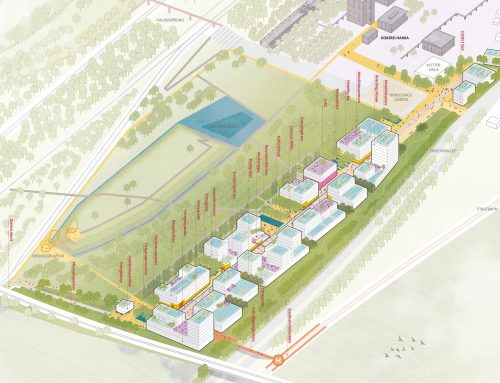
“Neues Wohnen im Haintal”
2. Prize in the urban planning competition “Neues Wohnen im Haintal” City of Heidenheim in collaboration with Koeber Landschaftsarchitektur
Two central open spaces, which have essential functions but are different in character, link the new quarter across the existing dividing lines. The project area is located in the eastern part of the city of Heidenheim and is nestled in the landscape, sloping towards Giengen in the Haintal valley. Gentle, leafy hills border the existing settlement, dating back to different time periods starting from the 1950s.

The quarter, characterized by terraced houses, detached rows and isolated higher points from the 1970s, has only a few public and social meeting points and is divided by two main items: Firstly, the busy country road in an east-west direction with an adjacent dry ditch. Secondly, the high-voltage power line in a north-south direction and the unobstructable area with underground water supply lines. The area thus appears as a series of areas on both sides of the main road without any inner coherence. This results in very narrow areas towards the edge of the forest which are difficult to build on, making a continuous development of the new neighbourhood challenging. The main quality is the direct access to the landscape.

Linking neighborhood and landscape
The basic urban design concept is to link the neighbourhood with the landscape through two central open spaces:
The Landscape: Along the high-voltage power line and the water pipeline running along it, the building exclusion zone, previously perceived as a residual area, will be enhanced and favourably reinterpreted as a green corridor. The established landscape will be routed through the entire settlement, terraced with a cultural landscape identity and selectively programmed with leisure functions. This visually and functionally connects the forest areas on both sides of the valley.
The urban ribbon: The cultural monument of the former Voith Bildungswerk is the starting point for another important public space. Another special building block is placed on the opposite side of the street. To enhance the urban character in this area, smaller businesses and supply points are located in the ground floor areas around both special building blocks.
Between these two corridors, the existing network of paths is complemented by additional pedestrian connections lined with rows of trees, developed from the surrounding context. Starting from the edges of the forest, they are guided through new and existing areas. This creates an identity-establishing network of landscape and buildings.
Communities
Four clearly defined sub-quarters develop between the two open spaces, each of which relates to the wider area to create the coherence of the residential area. An average building height of three storeys and the spatial positioning of the high points support the area as a unit. At the same time, the specific character of each neighbourhood gives rise to its own communities, which are characterised by different typologies and amenities.
Housing diversity
The divergent construction methods result in a diverse range of housing typologies and units for a mixed population. In addition to multi-story residences and subsidized housing, micro-apartments and affordable rental units for single parents are also on offer. Terraced and semi-detached houses are particularly suitable for young families. Intergenerational living is offered centrally on the neighbourhood square, while to the north of this, detached point buildings offer community housing projects and building cooperatives the opportunity to implement innovative and collaborative living concepts.
Special building blocks
The existing school is seen as a source of identity and inspiration beyond the local area. The existing listed building will house a daycare center, a community center and a multifunctional hall. Opposite this building is a sports hall with a youth center. The first floor areas are intended to be used as communal spaces for the neighborhood, co-working spaces and commercial uses.

Project information
Name: “Neues Wohnen im Haintal”
Location: City of Heidenheim
Project type: Competition 2nd prize
Year: 2018
Client: City of Heidenheim
Collaboration: Koeber Landschaftsarchitektur
Project team: Raphael Dietz, Henriette Commichau
Visualizations: asp Architekten