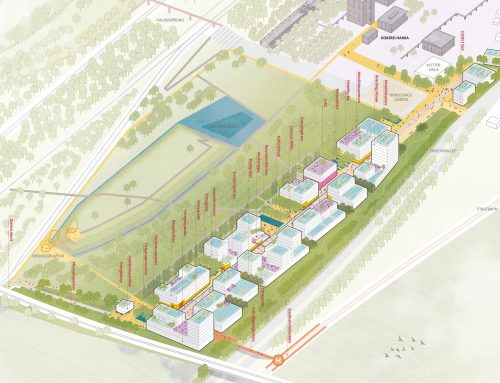
“New Urban Space B14”
First Prize: “Neuer Stadtraum B14” International Urban Planning Competition in Stuttgart, in collaboration with Koeber Landschaftsarchitekten/ Stuttgart, StetePlanung/ Darmstadt.
Transformation from a monofunctional transportation structure into a diverse living space – that is the guiding principle of our winning design. The aim is to create a maximally green urban space that fulfils the needs and aspirations of the people who live here. It is about the appropriation and reconquest of inner-city places and living spaces. To create places that connect and revitalise social structures and interactions in public spaces. Transport redistribution or visionary technical solutions are not the primary focus.
Our scheme takes up existing qualities, repairs weak points and divides the area into sections. Going beyond the requirements of the competition, we are not only devoting ourselves to reorganising the streetscape, but we focus our attention on the entire city centre. We analyse typical local situations and events, uncover old, buried relationships, create new connections and repair wounds that history has entailed – and always with interventions that are centred around people. The result is a lively, liveable urban fabric that offers space for numerous uses and purposes.

Surfaced – The reconquest of an urban highway
The B14 federal road cuts through the urban fabric of the state capital Stuttgart on stretches with up to ten lanes. The brief included redesigning the dividing traffic lane over a length of around five kilometres and continuing to implement the paradigm shift that had begun – away from the car-friendly city and towards the people-friendly city. The assumption that the volume of motorised traffic will be reduced by 50% in the future formed the basis of the project.


New places and living spaces
Traffic, which is currently routed underground through tunnels in many parts of the competition area, will be systematically brought to the surface. In addition, the road width will be reduced to two to a maximum of four lanes, creating space for cyclists and pedestrians. Crossing facilities at key locations strengthen the urban network. Valuable benefit: The freed-up space offers a wide range of opportunities for urban society – for living, working, culture, sport or other leisure activities.
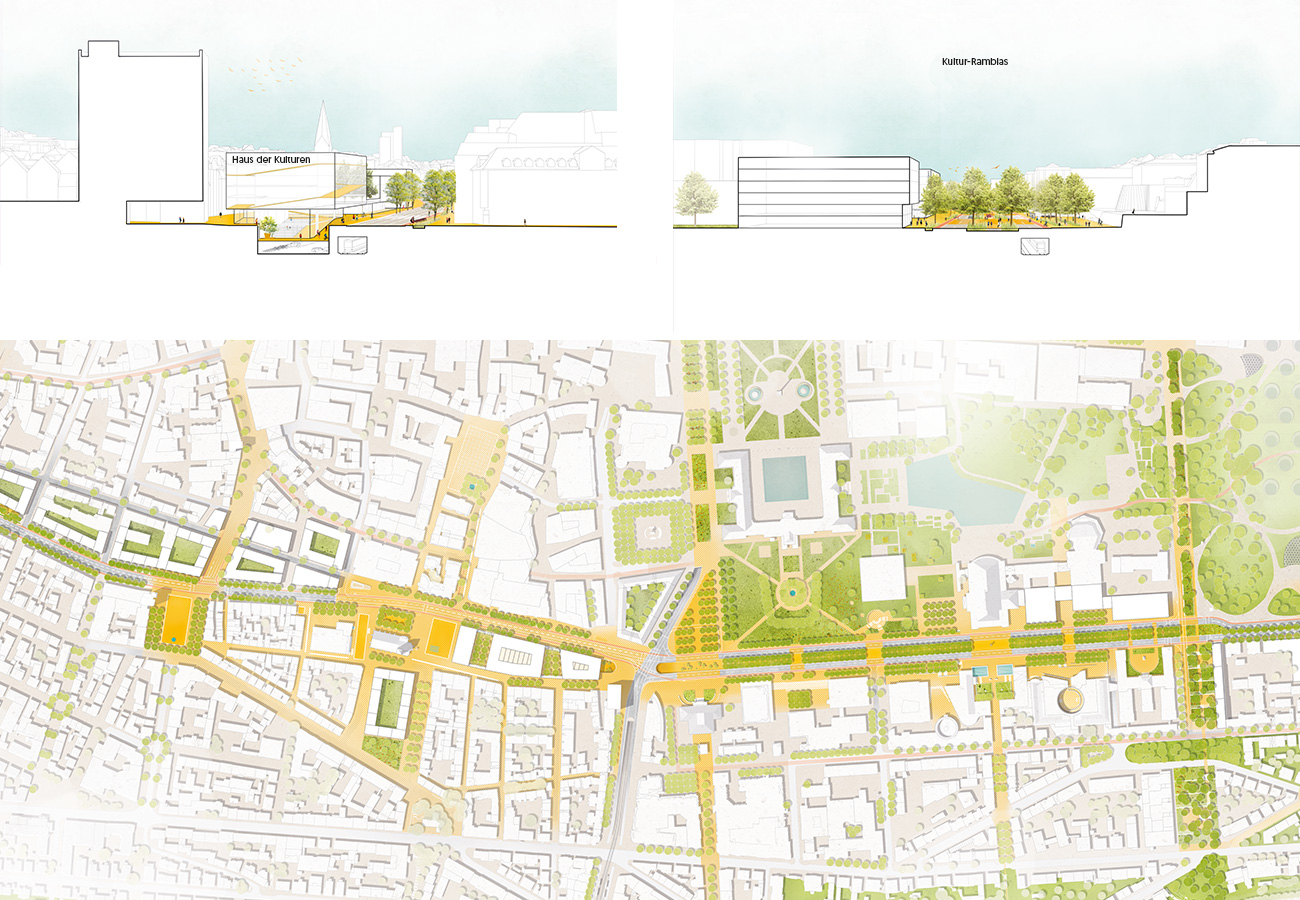
Rather than as a linear axis the street appears as a sequence of different areas for play, excercise and open spaces. Individual areas have been redefined and assigned to specific purposes and activities based on their location, significance and history. Based on these “urban rooms in public space”, the street is interlinked with its surroundings, old and new pathways are identified and enhanced.

Transformation instead of negation
The transportation structures of the car-friendly city represent a part of the city’s history. A total demolition would be tantamount to negating a significant part of recent history. Exits and tunnel areas are thus largely preserved. Around the Charlottenplatz underground station and Paulinenbrücke they will be transformed into urban spaces that can be used in many different ways. In other places, disused traffic areas are being converted into mobility and logistics hubs.
Extension of the Culture Mile
In the old town, the historic block structures will be incorporated and reinterpreted, and the edges of streets and squares restored. The newly constructed blocks in the Esslinger Strasse area will house important cultural institutions such as the Haus der Kulturen, the new Linden Museum and the Filmhaus. The Culture Mile is extended to Leonhardskirche/Gustav-Siegle-Haus. Thanks to the close connection with the area around the market square, the now enlarged quarter can develop into a new lively centre.

Urban ecology
The quality of urban spaces is closely linked to their ecological and climatic quality. Areas that become available will be largely designed to be unsealed and tree species will be planted to have an effect on the urban climate. The trees are not planted in tree grates as usual, but in wide green strips that are sown and planted with a wide variety of species to promote biodiversity. An ingenious rainwater management system ensures that the surface water reaches the subsoil via these green strips, where it becomes available to plants. All in all, these measures serve to protect against heavy rainfall, avoid heat islands and increase ecological diversity.
Project information
Name: “New Urban Space B14” International Competition
2020 Competition: 1st Prize in the “New Urban Space B14” International Urban Planning Ideas Competition
Location: Stuttgart
Client: Landeshauptstadt Stuttgart
Completion: offen
Planning Partners: Koeber Landschaftsarchitektur, StetePlanung
Project Team: Jana Melber, Elif Kälberer und Christiana Weiß
Photos / Visualizations: asp Architects / Koeber Landscape Architecture